
Why Energy Status Matters (And What BHBA Actually Tells You)
Let's talk about what happens inside a cow at calving. Cows store energy in fat reserves - you can see it in their body condition score. When they calve and start pumping out milk, they go into negative energy balance. The body responds by breaking down fat in the liver to keep up with energy demands. Problem is, this fat breakdown creates ketones, particularly Beta Hydroxy Butyrate (BHBA).
Higher BHBA levels mean the cow is burning through her fat reserves faster. Lower BHBA is what you want - it tells you the cow is in better energy status and not having to raid her reserves quite so aggressively.
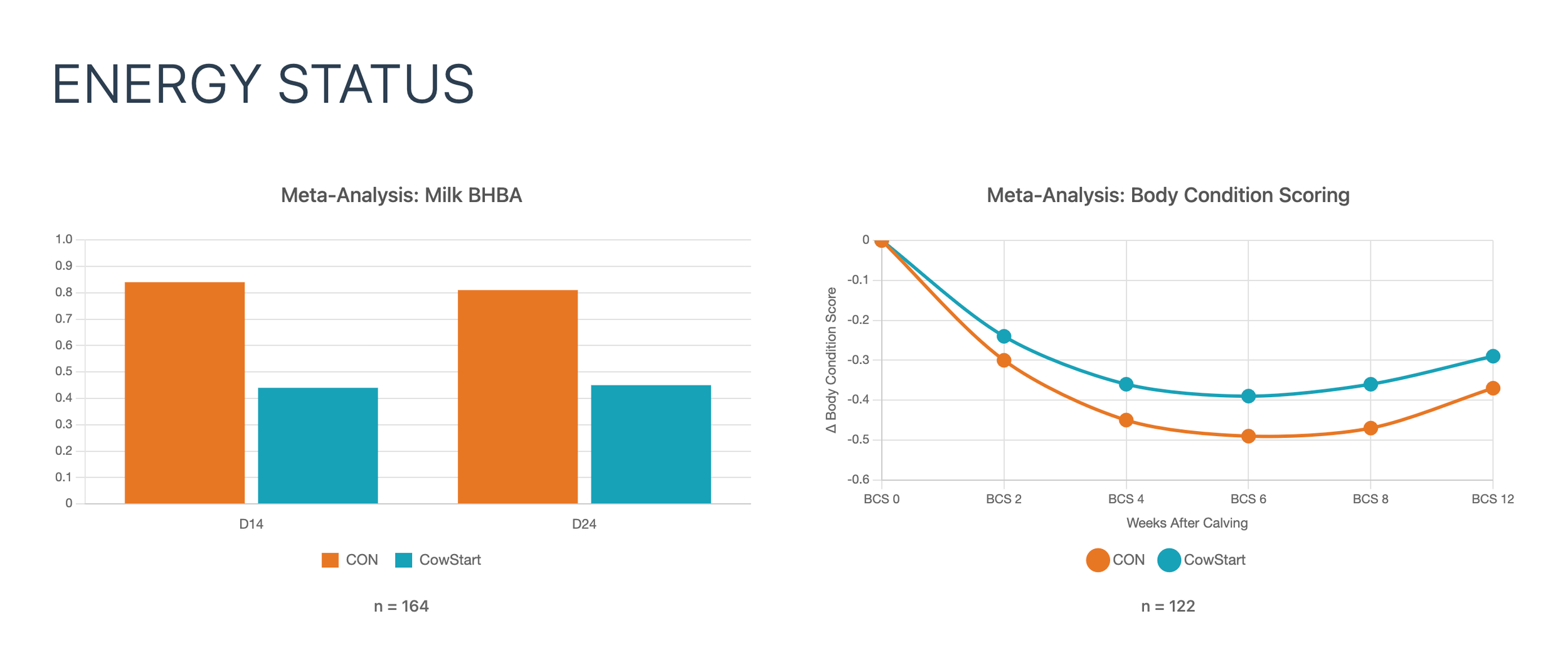
WHAT THE TRIALS SHOW:
Cow Start cows consistently show significantly lower milk BHBA scores and superior conservation of BCS across multiple trials. What does that actually mean for your cows?
Better energy status translates to:
Less body weight loss early in lactation
Quicker body condition score recovery
Cows that aren't burning themselves out to produce milk
THE CONNECTION YOU MIGHT NOT REALISE:
Here's the thing - calcium status and energy status are linked. When calcium is low, feed intake drops, rumen function slows, and the cow has to mobilize more body reserves to meet energy demands. By keeping calcium status right through those critical first 48 hours, you're helping keep the cow's energy balance in better shape too.
The trials back this up repeatedly - Cow Start cows maintain better metabolic status and hold condition better early in lactation. That sets them up for better production and fertility down the track, not just in the first few weeks. The Pihama trial is an excellent example of this. At the start of mating a significant weather event, combined with paddocks being held out for silage, caused a feed pinch. We saw production drop across both controls and Cow Start cows, yet when it came to submission rates the Cow Start group hit a 3-week rate of 92.6% while the controls faltered (63.2%). What’s more the Cow Start cows held their pregnancy - with a first service conception rate of 89.7% vs 63.1% in the controls. Why the difference? We think it’s metabolic status. The Cow Start Cows hit the pinch in great shape, no underlying pressure - they were already ahead on rumination minutes, had plenty of reserves. What we also saw is that once they got through the pinch their production bounced back better and they got on with making Paddy more milk. Meanwhile many of the controls went back around for another go with the AI tech. In the end empties tell the real story. Cow Start cows 3.5%, Controls 12.2%. As Paddy said: “Those kinds of numbers ought to sell plenty of your product”.
The Bottom Line
Early lactation energy status isn't just about avoiding clinical ketosis. It's about how hard you're making your cows work to produce milk. Lower BHBA, less weight loss, better condition recovery - these all add up to cows that perform better right through the season, not just cows that survive calving.
References:
Fahey, A., Lawlor. J., Cow Start Research Meta-analysis, 2022
Lawlor et al., “Effect of Cow Start Bolus Supplementation on Early Lactation Health and Performance Indicators in a Group of Older, At-Risk Dairy Cows”, Animal and Veterinary Sciences, 9(5): 134-140. 2021
J. Lawlor, A. Fahey, E. Neville, A. Stack, and F. Mulligan, “On-farm Safety and Efficacy Trial of Cow Start Calcium Bolus,” Anim. Vet. Sci., vol. 7, no. 6, pp. 121–126, 2019.
Lawlor, J., Fahey, A., Neville, E., Stack, A., and Mulligan, F. “Effect of Cow Start Calcium Bolus on Metabolic Status and Milk Production in Early Lactation”, Anim Vet Sci., vol. 8, no. 6, pp. 124-132, 2020.