
Why Immune Function Matters at Calving
Freshly calved cows are immunosuppressed - their immune system takes a hammering right when they need it most. Low calcium, negative energy balance, and oxidative stress all hit at once, and that's when you see metabolic issues and infections kick in.
HOW COW START COMPLETE HELPS:
Cow Start Complete is designed to support immune response through three main pathways:
Better calcium status - calcium is crucial for immune cell function
Better energy status - less metabolic stress means immune cells can actually do their job
High levels of rumen-protected Selenium and Vitamin E - boosts antioxidant status when oxidative stress is at its peak
It's not just about one thing - it's the combination that makes the difference.
THE NUMBERS FROM OVER 450 COWS:
A meta-analysis review of 4 years of Cow Start research covering over 450 cows shows some pretty compelling reductions in the key metabolic problems:
Milk Fever Prevention - The Real Difference
When it comes to clinical milk fever, not all calcium supplementation is equal:
Cow Start Complete: 85-100% reduction in clinical milk fever risk
Compare this to:
Single dose bolus: 43% reduction in risk
Double dose boluses (12 hr between doses): 50-60% reduction in risk
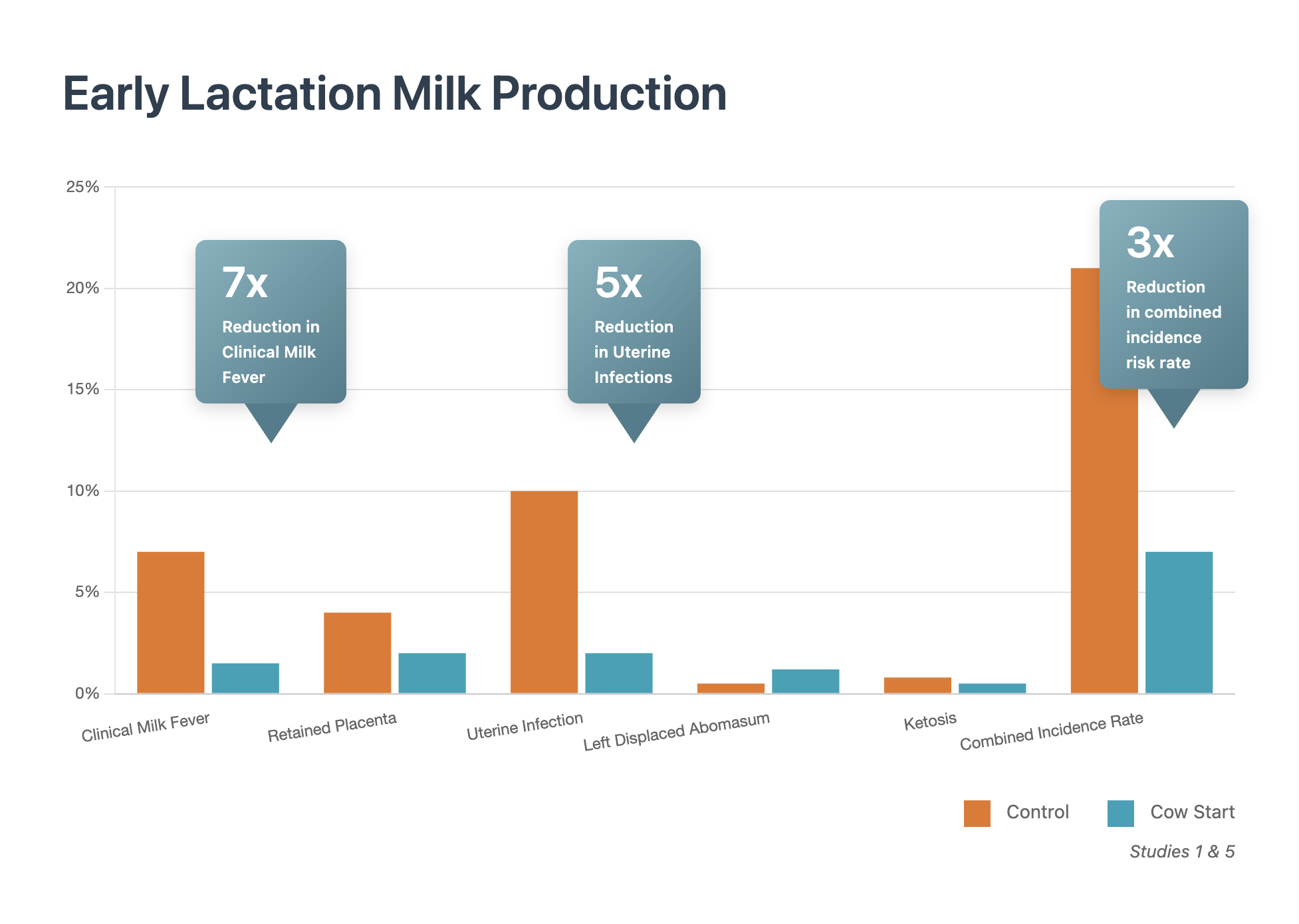
That 7-fold reduction the trials show isn't just impressive on paper - it's the difference between having clinical milk fever cases most seasons versus rarely seeing them. The 48-hour calcium delivery is what makes this possible, while short-acting boluses run out of steam before the danger period is over.
OTHER METABOLIC BENEFITS:
Overall metabolic disease risk (including clinical milk fever): Drops by a factor of 3 (P<0.05)
Uterine infections: Reduced by a factor of 5 (P<0.05)
Retained placenta: Reduced by a factor of 2 (numerical reduction)
These aren't small differences - these are the kind of reductions that actually change how your calving season runs. You’ll probably notice at Metricheck time. Farmers tell us they simply don’t see as many positive cows.
WHAT THIS MEANS FOR YOUR HERD:
Fewer sick cows mean:
Less time spent treating
Lower vet bills
Better fertility outcomes (hard to get in-calf when fighting a uterine infection)
Cows that can actually focus on producing milk instead of fighting disease
The immune system can't function properly when calcium is low, energy reserves are depleted, and oxidative stress is high. Fix those foundations in the first 48 hours, and you set the immune system up to actually protect the cow through the critical transition period.
THE BOTTOM LINE:
You can't eliminate all metabolic disease - transition is tough on cows regardless. But you can significantly reduce the risk by giving the immune system the support it needs when it's under the most pressure. The trial data across multiple farms and production systems shows this approach works consistently.
References
1. Fahey, A., Lawlor. J., Cow Start Research Meta-analysis, 2022
2. Lawlor et al., “Effect of Cow Start Bolus Supplementation on Early Lactation Health and Performance Indicators in a Group of Older, At-Risk Dairy Cows”, Animal and Veterinary Sciences, 9(5): 134-140. 2021
3. Spears JW1, Weiss WP. Role of antioxidants and trace elements in health and immunity of transition dairy cows. Vet J. 2008 Apr;176(1):70-6.
4. J. Lawlor, A. Fahey, E. Neville, A. Stack, and F. Mulligan, “On-farm Safety and Efficacy Trial of Cow Start Calcium Bolus,” Anim. Vet. Sci., vol. 7, no. 6, pp. 121–126, 2019.
5. Lawlor, J., Fahey, A., Neville, E., Stack, A., and Mulligan, F. “Effect of Cow Start Calcium Bolus on Metabolic Status and Milk Production in Early Lactation”, Anim Vet Sci., vol. 8, no. 6, pp. 124-132, 2020.
Clinical Milk Fever Efficacy: Single dose calcium bolus efficacy based on Leno et al. 2018 (J. Dairy Sci. 101:3285-3302), showing 43% reduction in calcium retreatment for multiparous cows with low calcium (Table 8, RR=0.57). Double bolus (multiple dose) efficacy based on Thilsing-Hansen et al. 2002 meta-analysis (Acta Vet. Scand. 43:1-19), showing 50-60% mean efficacy for milk fever prevention. Cow Start Complete efficacy based on Lawlor et al. 2024 (Anim. Vet. Sci. 12(6):154-160), demonstrating 0% clinical milk fever incidence in supplemented cows vs 13.3% in controls.